

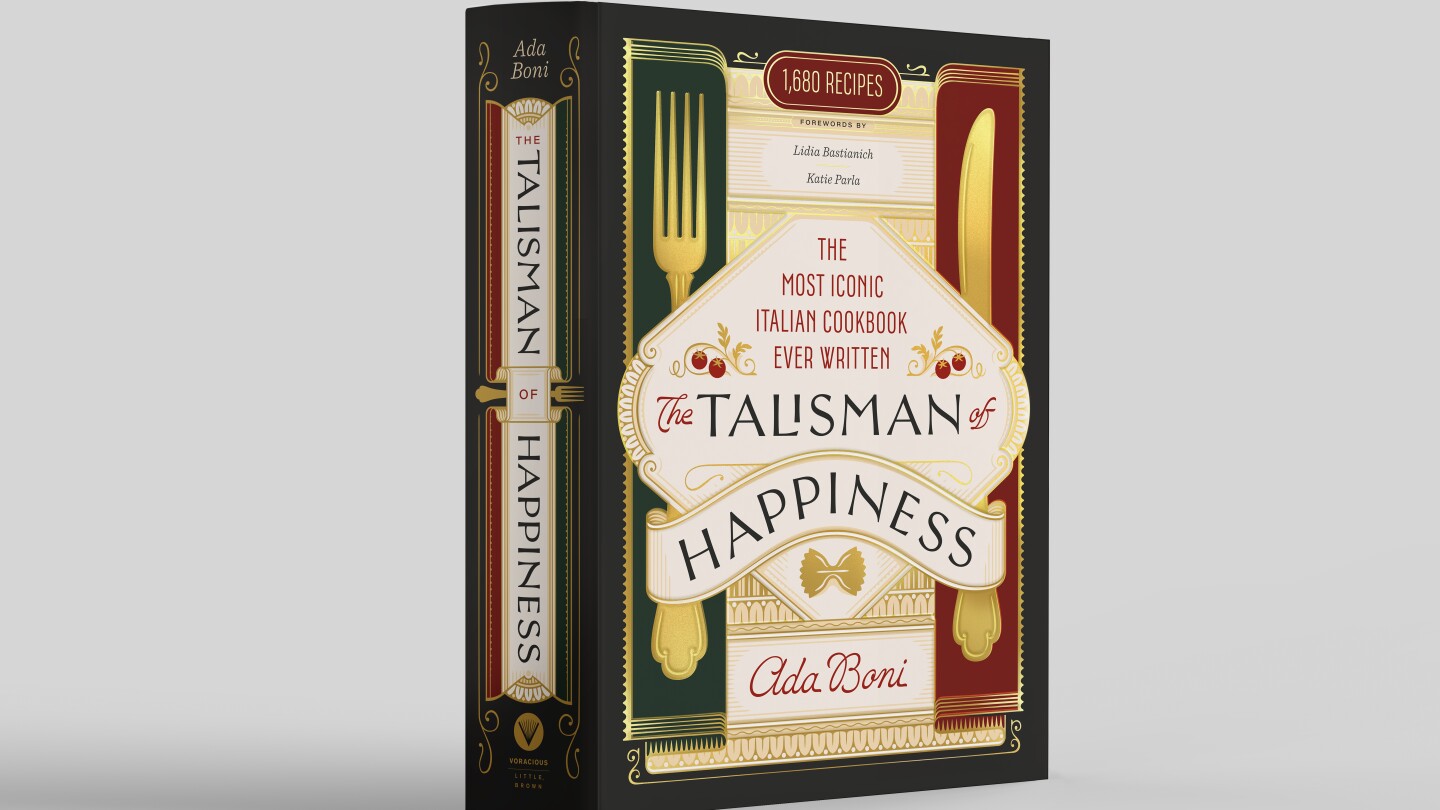
NEW YORK (AP) — As a child growing up in Italy, Lidia Bastianich recalls seeing one particular cookbook in just about everyone’s kitchen. It was called “The Talisman of Happiness” and it was often given as a wedding present to couples starting new lives together.
“It has all the basic recipes. And it says the basic thing — that food is a connector, that food is happiness,” she says.
The book by Ada Boni — its Italian title is “Il Talismano della Felicita” — was first published in 1929, and became a go-to place to find the recipe for spaghetti carbonara or pork galantine. Its simplicity and accessibility got it compared to “The Joy of Cooking,” but it predated Irma S. Rombauer’s iconic work.
This fall, the first English edition of the complete work — with nearly 1,700 recipes — arrives on shelves, thanks to years of dogged pursuit by Voracious publisher Michael Szczerban.
The hunt is on
He first heard about it from Samin Nosrat, author of “Salt Fat Acid Heat,” and that, combined with his love of Italy, led him on a more than decade-long journey to get the rights to publish it in English. “Just the poetry of that name — ‘The Talisman of Happiness’ — it felt timeless and also like it was from so long ago,” Szczerban says.
Boni, who died in 1973, was one of Italy’s first food writers, and the seeds of “The Talisman of Happiness” grew from a magazine. She codified and tested dishes that have remained the backbone of Italian cooking and reflect regional differences. There are 10 gnocchi recipes, 12 minestrones and 20 risottos.
“This is a cookbook that’s really meant for cooking. It is a book for cooks. It’s a book that’s intended to be used, not just to sit on a coffee table or on a shelf, but to become yours,” says Szczerban.
There’s no frilly language or stories. Each entry includes ingredients, and the directions are usually just a few paragraphs, telling the home cook to look for the meat to be “done” and the vegetables to be seasoned “to taste.”
Unlike recipes from Milk Street, Bon Appetit or America’s Test Kitchen, Boni didn’t weigh things to the gram or even dictate oven degrees. Her Cod with White Wine only specifies “a few spoons” of wine. Elsewhere, she calls for a “finger of oil” or “a few leaves of rosemary.”
“I think that there was a very specific editorial vision for these recipes, which was to give you enough to make it, but not so much that you couldn’t make it your own,” Szczerban says.
A 12-year sleuthing adventure
The more Szczerban learned about “The Talisman of Happiness,” the more intrigued he became. What at first was an impulse to find a copy for himself grew into something larger.
“As I began to understand more of what it was — the place that it seemed to have had in Italian history and culture, and then the spread of Italian cooking throughout the world — I thought, ‘I don’t need just a copy of this. I need to be able to use my position as a publisher to bring this to the rest of the English-language world,’” he says.
The book had been updated regularly in Italy and there had been a few stabs at an English version, but the recipes were changed in order to tailor them to American tastes and heavily abridged. “Nobody had translated the full beast,” Szczerban says.
Szczerban started a sleuthing adventure that took some 12 years — calling random numbers at the Italian publisher with a script created from Google Translate, poring over bankruptcy reports to see who might have inherited the intellectual property rights, and talking to every Italian book figure and agent he could.
A breakthrough came when he contacted a book packager — like a movie producer, but for books — who knew somebody who knew someone else who maybe could locate a relative. A few months later, they found a great-nephew. “I think you needed somebody on the ground in Italy to unlock the relationship of trust,” says Szczerban.
He decided to use the 1959 Italian edition as the model, tapping eight translators. He removed only recipes that were completely unworkable and sections on Italian etiquette that were dated. The original edition was constantly consulted.
“We wanted it to be Ada’s book, still. We weren’t trying to modernize it. We were trying to preserve it and to keep it intact,” he says. “The word talisman, to me, has such power. I wanted it to be the talisman it was back when it was first published.”
Bastianich wrote a forward for the English edition and says it captures the culture, religion, topography and climate of Italy. “Italians really, really cherish their cultural heritage,” she says.
Szczerban has already seen it in effect. For an office potluck, a sales rep who liked the book decided to make Baked Wine Donuts — a sort of shortbread cookie with wine mixed into the flour.
“She’s not a baker. She’s never seen this thing before. But there was something intriguing about it that got her into the kitchen and, I’ll tell you, these were amazing,” he says.
“They turned out the first time, and going out a little bit beyond her comfort zone gave her the confidence to take on the next recipe and the next recipe. To me, that is kind of the magic of a book like this: It can seduce you in some way, but then it gives you something back.”
___
Baked Wine Donuts
Makes 36
Ingredients
3⅓ cups all-purpose flour
¾ cup olive oil
½ cup sugar
¾ cup wine
Oil for greasing
Directions
Put the flour in a heap and add the oil, sugar, and a glass of light wine, white or red, in the well in the middle. You need a paste that is neither too hard nor too soft. Make it into a ball, let it rest for a few minutes, and then divide it into 4 or 5 pieces.
Take one piece at a time and stretch it over a lightly floured board to make a roll the width of your thumb. Cut this into pieces of about 8 inches and make a donut out of each one, pressing the ends together so that they do not then open. Proceed in the same way until all are used up.
Line up the donuts on a lightly oiled baking sheet, sprinkle them with sugar, and bake them for about 20 minutes in a preheated oven at a good heat.
___
Excerpted from “The Talisman of Happiness” by Ada Boni. Copyright (copyright) 2025 by Elwin Street. Used with permission of Voracious, an imprint of Little, Brown and Company. New York, NY. All rights reserved.